

Chapel of Our Lady of the Rosary
Chapel of Our Lady of the Rosary
Chapel of Our Lady of the Rosary
Audio transcription
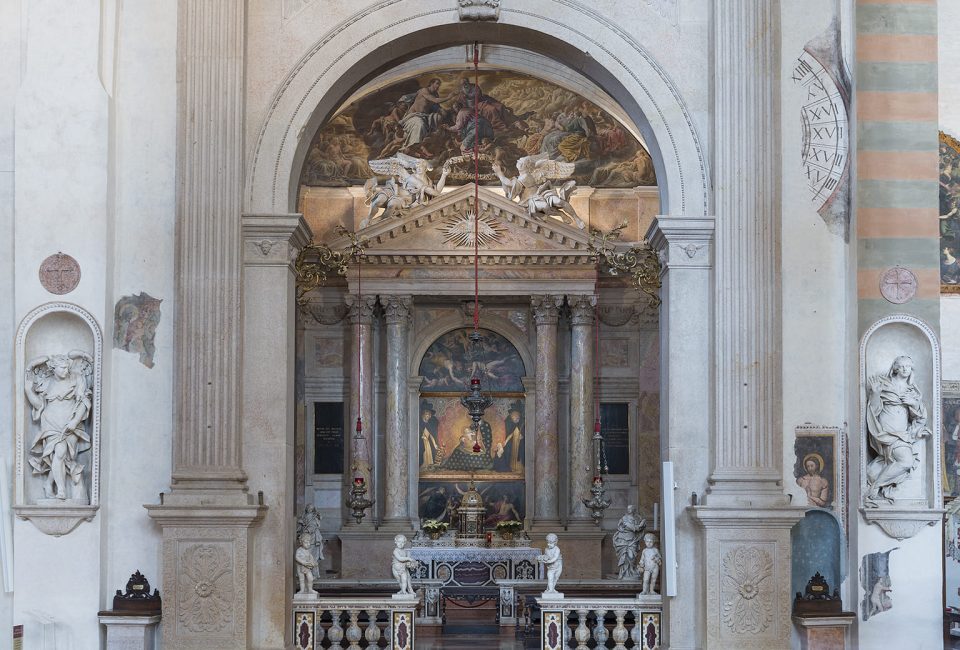
The Chapel of the Rosary was built in 1585 by Domenico Curtoni, grandson of the architect Michele Sanmicheli upon commission of the Society of the Rosary, established after the victory of the Battle of Lepanto. On the altar the splendid painting by Lorenzo Veneziano (dated between 1358 and 1359) depicting a Madonna of Humility has been placed temporarily. Next to her, St. Peter Martyr and St. Dominic introduce the two commissioners, Cangrande II and his wife Elizabeth, kneeling in the foreground.
It is tempera on canvas and not on a board, as was the custom at that time. The Virgin is nursing the child, wearing a starry mantle, clasped together on the chest by a precious clip: her hands caress the child but her gaze goes further and rests on the kneeling worshippers and on those looking at the painting. Lorenzo Veneziano added the iconographical attributes of Mary, Woman of the Apocalypse to the traditional image that showed the Madonna meekly lying on a flowery meadow: she is enveloped by the sun, crowned with twelve stars, and at her feet a small crescent moon is depicted. She is surrounded by a luminous globe, in which heavenly hosts of angels who adore her are depicted. An inscription runs all around the canvas: it is four stanzas from Marian hymns, used in the celebration of the Dominican Mass. The Angelic choirs around the painting are from 1607, the work of Alessandro Turchi. There are sculptures by the Bolognese Gabriel Brunelli. By the lunettes, we find 17th century canvases of the Coronation of the Virgin, by Marcantonio Bassetti, on the sides of the window of the left bezel there is the Annunciation, by Dario Pozzo, in the lunette above the entrance there is Adoration of the Shepherds by Biagio Falceri and, to the right the Deposition, by Giambattista Rossi. In the dome: the Assumption of Mary, and in the spandrels, St. John, St. Mark, St. Luke and St. Matthew by Giovanni Lorenzetti. On the right wall, Prayer in the Garden, by Pietro Bernardi dated 1623. On the left wall, the Flagellation by Claudio Ridolfi, 1619. The external balustrade, decorated with four cherubs, was done in 1636.