

Pellegrini Chapel
Pellegrini Chapel
Pellegrini Chapel
Audio transcription
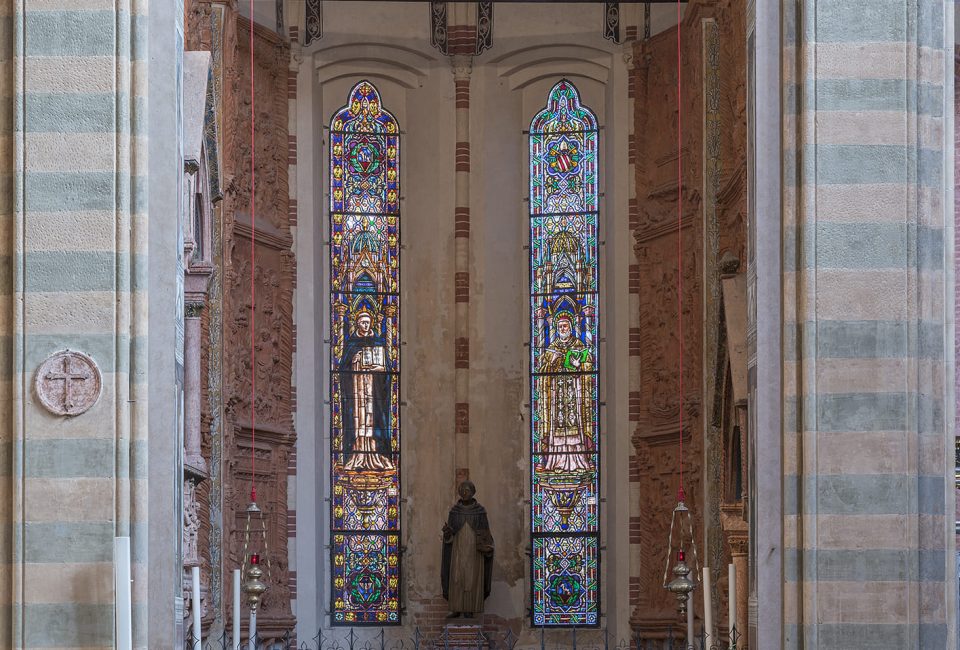
The Pellegrini Chapel is located to the right of the main altar.
On the right side there is the Bevilacqua – Pellegrini tomb with a frescoed lunette by Martino da Verona (late 14th – early 15th century). On the left, the Pellegrini family tombs with frescoes attributed to the school of Altichiero (second half of the 14th century). In this Gothic-Cortese context, the 24 terracotta tiles, once polychromatic, created by Michael of Florence in 1435 are innovatively set, depicting episodes from the life of Christ.
Stepping back a few steps and looking up to on the outside front of the arch of the chapel, you can admire the most famous work of art in the Basilica of Sant’Anastasia: the fresco of St. George and the Princess by Antonio Pisano, known as Pisanello. Commissioned as a bequest by Andrea Pellegrini, the fresco by Pisanello was painted between 1433 and 1438, the work of art came to us without “Saint Eustace petting a dog” and “armed Saint George ” which complemented the cycle, as we are reminded by Vasari in his “Lives of the painters”. The story of St. George and the Princess is described in the Legenda Aurea by Jacobus de Voragine. The artist divides the scene into two areas: the right represents the tension-filled moment in which Saint George is preparing to face a dragon that threatens the city. On the left, beyond the lake, amongst reptiles and animal carcasses there is the dragon, with the features of a large lizard. St. George is about to mount a horse, with a foot in the stirrup and an eye toward the enemy line; the princess silently watches and waits for the outcome of the battle that will determine his fate. The profile portrait is famous, also referred to by Pisanello in some medals, and is stylishly accentuated by the hairstyle that according to the fashion of the period involved shaving the forehead to ennoble features. The royal procession, composed of richly attired nobles and strange characters with exotic shapes and appearances, comes down from a fairy tale city, sometimes called Silene, at others Trebisonda. In the background, there is the enigmatic representation of two hanged men: it could merely be a test of mastery by Pisanello in the study of realism (for a period the painter lived next to the Piazza della Forca (Square with gallows), but could also be an allusion to earthly justice to be used for the murder of member of the commissioning family. Although the fresco is now deprived of the entire ensemble of coloured glazes, metallic foils and plumage that almost made it a gold and silver artefact, it still retains the fairy-tale atmosphere of the gothic-cortese world of Pisanello. Here he is at the height of his career after returning from a trip to Rome. He demonstrates how he mastered the lessons of his teacher Gentile da Fabriano creating his own language made up of enchantment and magic, where the dreamy atmosphere of the myth of chivalry, typical of the international Gothic style, comes together with the acute recognition of natural information enhanced in the observation of realism and in the study of animals. Even testimonials from the 18th century mention the advanced state of degradation in which the work was due to rainwater infiltration. At the end of the 19th century, the fresco was removed from the wall, split into two parts which were later put back together on a canvas backing and positioned in the nearby Giusti Chapel. It remained there until 1996 when the local Superintendency chose to return it to its original position at the front exterior of the Pellegrini Chapel.