

Central nave
Central nave
Central nave
Audio transcription
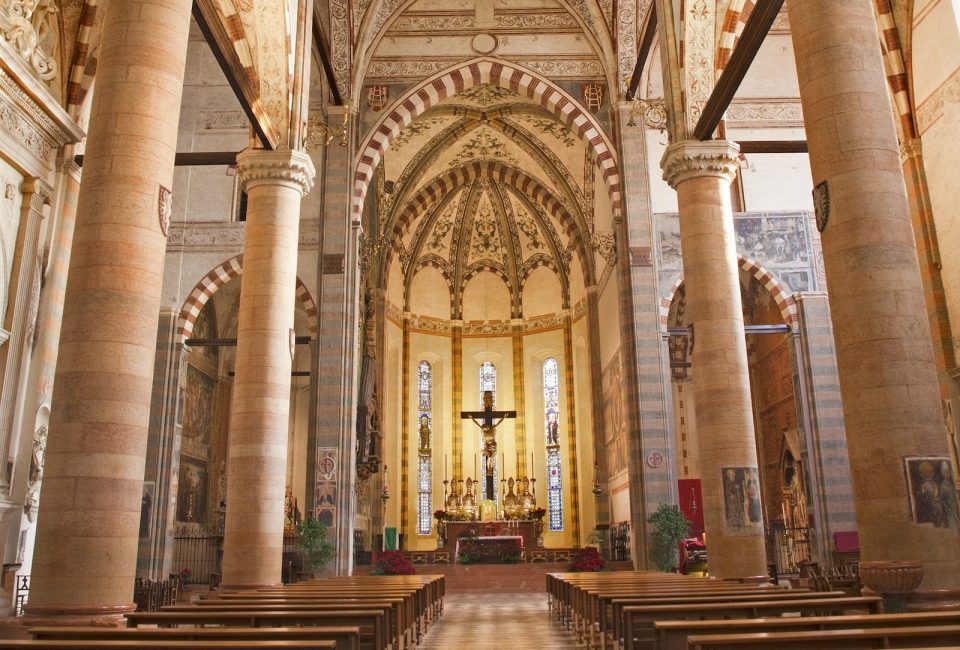
Sant’Anastasia is the largest church in Verona. The basilica is divided into three large naves with vaulted ceilings supported by 12 massive columns of red marble from Verona.
In the transept, five chapels open out. On the left side lies the old sacristy. It would appear that in 1320 the five apses, the transept and the first two bays of the nave had already been completed. Note on the first two pairs of columns, starting from the presbytery, the 14th century emblem of the Castelbarcos, a white rampant lion on a red field and on the arch of the chancel the emblem of the Scaligeri family: a staircase with a dog.
The interior of the Basilica is today a large open space and the high altar is clearly visible from the main entrance. Until the end of the 16th century, however, the view was interrupted by a “narthex” a partition that separated the assembly area of the laity from the presbytery, hiding the Eucharistic celebration that took place on the high altar. Even today there are visible patches on the floor in the second bay between the side door on the right and the organ to the left, reflecting the original location of the narthex.
Thanks to the different ceiling decorations we can identify the various stages of construction, which lasted at least two hundred years. The oldest decoration is from the 14th century and is visible in the transept and the first bay.
In the next bay the 14th century scroll was reworked and revived to fit in with the 15th century decoration. In the fourth bay in the ribbing, the image of St. Peter Martyr is repeated four times, recognisable by his dagger in the chest and the axe in the head, in the act of protecting people under his cloak. In the fifth bay of one side of the ceiling, the date 1437 is engraved and on the other side, the initials IB, the signature of the painter Giovanni Badile.
In the circles of foliage, the Dominican Order is celebrated: we can recognise St. Peter the martyr who holds the city of Verona on his shoulders and Saint Dominic with the model of the Basilica of Sant’ Anastasia.
In the side aisles images of Dominican nuns alternate with symbols of the Evangelists and Doctors of the Church, while in the circles of the last bay there is the embrace between St. Dominic and St. Francis that seals the union between the two monastic orders. The Basilica was consecrated in 1471, but in later centuries new altars and chapels adorned with masterpieces were built, especially during the Renaissance period, which makes the Basilica of Sant’Anastasia one of the richest of all of Verona.